SPARX Japan Value Creation Strategy The Role of Share Buybacks and Strategic Investments

Chief Analyst SPARX Japan Value Creation Strategy
There is an increasing trend of share buybacks among listed companies in Japan. This shift signifies a move from management focusing solely on P&L (profit and loss statements) metrics such as sales and profits, to a more balanced approach that also considers the balance sheet (BS) and optimal allocation of management resources. This positive trend should deserve recognition.
Many listed companies announce their financial results in May. This year, it is noticeable that more companies are announcing share buybacks alongside their earnings reports. This trend reflects the ongoing response to the Tokyo Stock Exchange's (TSE) "Request for Action to Implement Management Conscious of Cost of Capital and Stock Price." It suggests that companies are increasingly aligning with the TSE's guidelines.
However, the TSE has clarified that it does not advocate for mere short-term responses like share buybacks or increased dividends alone. The primary focus should be on sustainable growth, with share buybacks or dividends being considered only when there are no appropriate investment opportunities.
Comparing the Japanese stock market from March 2023, when the TSE's request was issued, to now, we see an upward trend. Yet, the proportion of companies with a Price-to-Book Ratio (PBR) below 1x remains high at about 40% (as of the end of April 2024, among TOPIX constituent companies). PBR can be decomposed into Return on Equity (ROE) and Price-to-Earnings Ratio (PER). Furthermore, ROE itself can be broken down into net profit margin, total asset turnover, and financial leverage. Compared to the U.S. and Europe, Japanese companies tend to have lower net profit margins, highlighting the need to strengthen their earning power through proactive investments in sustainable growth.
This growth should not come from short-term improvements in profit margins achieved by cutting research and development expenses or personnel costs. Instead, a long-term approach focused on growth investments, exiting unprofitable businesses, and optimizing the business portfolio by concentrating resources on core and growth areas is essential.
In this context, the role of outside directors is becoming crucial. The number of independent outside directors in TSE-listed companies has increased from 1,349 in 2013 to 7,055 in 2023, reflecting more than a fivefold increase over the past decade. Unlike directors appointed through internal promotions, outside directors can speak and act without deference to the management or specific departments. Their fundamental role is to supervise management on behalf of shareholders.
-
-
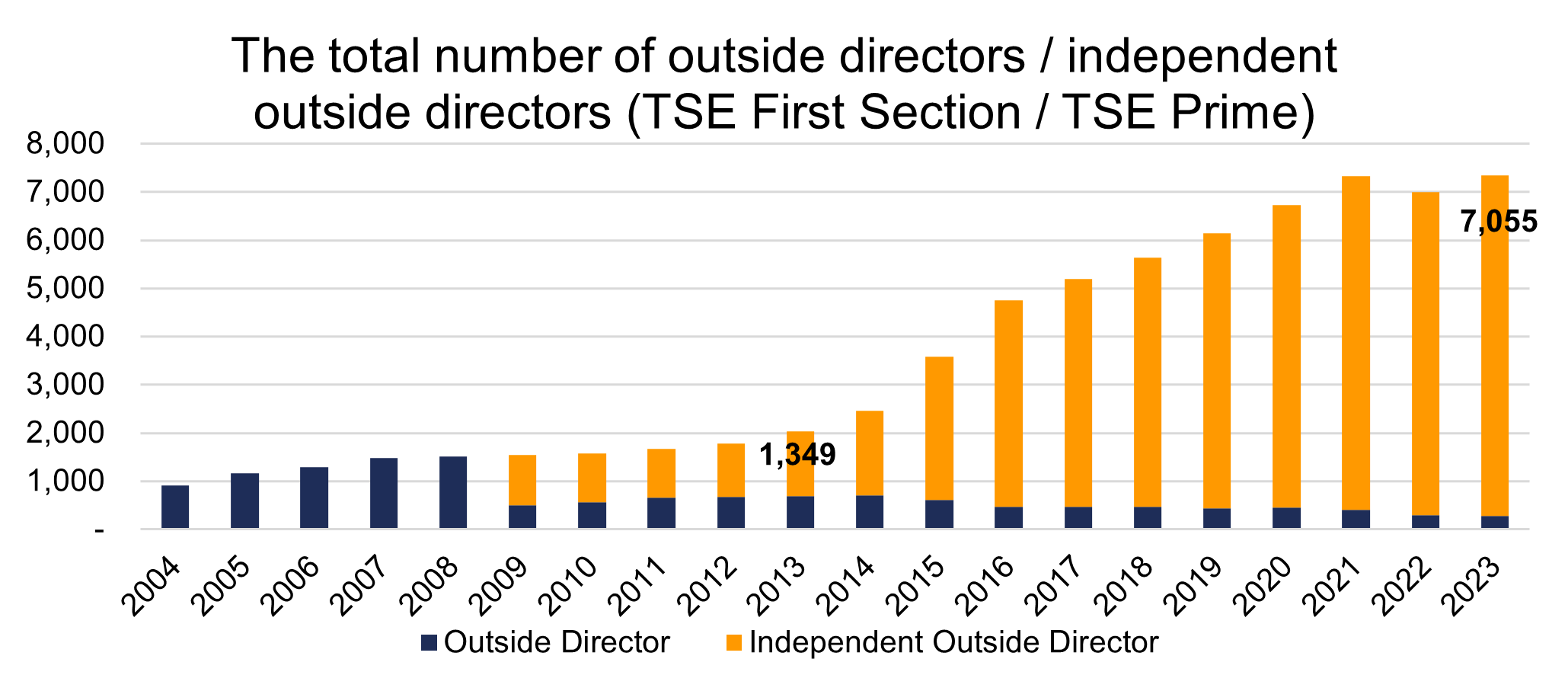
Source: SPARX Asset Management Co., Ltd., Japan Association of Corporate Directors "Corporate Governance Survey of Listed Companies" (August 1, 2023)
-
Strengthening earning power requires uncompromising structural reforms, including the divestiture of unprofitable businesses, which outside directors can support without being entangled in internal company politics. Additionally, "offensive governance" is vital to ensure that investments in core and growth businesses are not overly conservative and that appropriate risk-taking is being pursued. The Corporate Governance Code also mandates that board of directors create an environment that supports appropriate risk-taking by senior management.
By optimizing the business portfolio and ensuring appropriate risk-taking, I hope to see a robust strengthening of earning power from a long-term perspective, ultimately leading to Japan as a whole returning to a growth trajectory.
Important Disclaimer
This content has been prepared by SPARX Asset Management Co., Ltd. (SAM) for information purpose only. Certain information contains economic trends and performance, however, SAM does not warrant the accuracy or completeness of such information, and accept no liability whatsoever for any direct or consequential loss arising from any use of this content. The views and opinions contained herein are based on then-current beliefs of the authors and are subject to change without notice. Furthermore, it should not be assumed that past performance is an indication of future results.
