SPARX Japan Equity Focus All Cap Strategy Yen and Beyond: How Currency Fluctuations Shape Japanese Business

Portfolio Manager, SPARX Japan Equity All-cap Strategy
My base-case macroeconomic scenario from 2022 and beyond is "higher for longer inflation" and "the normalization of interest rates".
As a macro-agnostic, pure bottom-up stock picker, I do not make investment decisions by relying solely on macroeconomic data and forecasts. My primary focus is always on whether individual businesses' economic characteristics are attractive to me as a shareholder. But that does not mean I have no perspective on the current state of the economy and its forecasts. I believe that the key future considerations for the Japanese stock market are "higher for longer inflation" and the "normalization of (domestic) interest rates". Even if there is anticipation for a temporary inflation slowdown shortly, my base-case scenario at this juncture is that domestic inflation could become higher than the stock market's consensus in the long run based on pieces of anecdotal evidence we observe on the ground (i.e. structural labour shortages arising from demographic declines, etc.). This will likely put upward pressure on long-term interest rates as well. Under such circumstances, I believe that high-quality Japanese businesses with global exposure as well as such companies that also benefit from rising domestic interest rates are attractive investments.
The yen depreciated despite the BOJ's recent rate hike.
In March this year, the Bank of Japan (BOJ) took the long-awaited step of raising interest rates for the first time in 17 years. Contrary to the popular belief that the Japanese yen (JPY) would rise against USD post the hike, it has depreciated further. Why?
JPY, just like any currency, is traded on the foreign exchange market, reflecting various domestic and international factors. Among these, the key factors currently are Japan's real interest rate and the Balance of Payments, in my view:
1) The interest rate level of the JPY is still negative in real terms, despite the nominal rate turning positive after the rate hike (overnight call rates were guided to a range of 0.0~0.1% from minus 0.1%), leading to an investor preference for foreign currencies with higher interest rates.
2) The demand for JPY has structurally decreased owing to changes in the composition of Japan's export industry base over the past 20 years.
The real interest rate, mentioned in 1), is defined as the nominal interest rate minus expected inflation. The current inflation expectation based on inflation-linked 10-year JGB is about 1.42% versus the yield on 10-year JGB is 0.87%, so the real interest rate comes out to minus 0.55%. On the short end of the yield curve, the difference between the nominal rate (0.1%) and the current inflation rate (CPI at 2.0<%) is even wider (real rates are even more negative). What matters for the consumer and businesses' investment decisions is the real interest rate not nominal. When the real interest rate is negative, purchasing power is eroded due to inflation, even if interest is earned on bank deposits. Alternatively, it is advantageous to borrow in JPY and invest in foreign assets denominated in higher interest-rate currencies.
While the real interest rate in Japan continues to be in negative territory, the real interest rate in the US (10-year US treasury 4.7% vs inflation-linked bond 2.3%) is about a positive 2%. The interest rate gap between the USD and JPY remains wide, creating a conducive environment to favour owning the USD over JPY. Since around 2022, when central banks around the world began raising interest rates to curb red-hot inflation, real interest rates have turned positive for many currencies, however, Japan remains one of the few countries, if not the only, with negative real interest rates today. From a global perspective, JPY should be the least-favoured currency as a result.
2) with reference to the change in the supply and demand of JPY arising from changes in Japan's trade balances, Japan, a major exporting country, has long been in current account surplus (the trade surplus being the driving force), because domestic exporters regularly need to buy JPY to exchange USD they receive as export proceeds. Regardless of the interest rate differentials with other currencies, many businesses were constantly in need of foreign exchange.
In 2023, Japan's current account was in surplus again (CY2023 preliminary figure 20.6tn yen according to the Ministry of Finance, Japan), however its composition has changed dramatically over the past 20 years. Japanese companies have built factories overseas instead of exporting from Japan creating so-called the "hollowing out" of domestic manufacturing base. When this happens, profits earned overseas are often reinvested locally without being remitted to Japan, reducing the need to exchange for JPY. In the current account balance, this profit from overseas is recorded as "primary income"(34.5tn yen of surplus), but in terms of actual cash flows, it often does not return to Japan. Additionally, Japan's electronics industry's prolonged loss of market share to South Korean and Chinese companies contributed to the shrinkage in trade surplus (6.6tn yen of deficit).
Elsewhere in Japan's current account balance, the "services income" is in deficit (3.2tn yen deficit). This has to do with the increasing importance of intellectual property rights usage fees and the like paid out of Japan as the industrial structure becomes more software oriented. While Japan has many companies that excel in the manufacturing of physical goods, few companies globally deploy intangible assets such as software and intellectual property to earn foreign currency compared to the US and Europe. Japan is effectively paying foreign companies to use their services, constantly creating JPY selling and foreign currency buying.
Another factor that cannot be ignored is the revamped NISA (Nippon Investment Savings Account) program, which has significantly expanded the maximum tax-free investment amount since January this year. The amount of investment in foreign stocks and foreign bonds (including investment trusts) by retail investors under the new scheme has ballooned. With big-hit investment trusts like "All-Country" stock mutual funds, which are target stocks all around world at the forefront, purchases of more than 2tn yen were made in the first 3 months of this year which translates into an annual capital outflow of 8.0-9.0tn yen to overseas. This is recorded in the financial account of the balance of payments. The total Japanese household financial assets exceed 2,000tn yen with a large portion of it sitting in bank deposits earning almost no interest income. Even a tiny piece of this invested overseas could have a sizable impact on JPY supply and demand. Some even call it "stealth capital flight" and the trend should be a bit concerning in my view.
On the other side, if there are people in Japan who want to buy JPY now, they would be international tourists. If the number of visitors to Japan and the amount of per-person consumption rise, the demand for JPY should naturally increase. Japan offers a broad variety of tourist attractions (from world-famous ski fields to scuba diving spots, and many big cities and historic sites in between), and with the help of the weak yen, accommodation fees, service prices, prices for eating etc are incredibly cheap when viewed in USD terms (a middle-class foreigner can afford a 5-star hotel and a Michelin-starred restaurant with relative ease). Similarly, the ongoing large-scale construction of new fabs in Japan by overseas semiconductor manufacturers such as TSMC's Kumamoto factory is motivated by Japan's low geopolitical risk, the abundance of highly skilled domestic engineers (who can be hired at low salaries by international standards), and JPY's cheapness which makes the investment cost from the USD perspective considerably low. However, neither the increase in inbound tourists nor the presence of overseas semiconductor companies has reached a scale to outweigh the above-mentioned yen-selling factors.
JPY will likely remain cheap going forward.
The situation of Japan's balance of payments can be summarized as follows:
- The amount of foreign currency earned by Japanese exporters has decreased, reducing the need to exchange for JPY (reflected in the trade balance within the current account)
- The number of Japanese people using digital services from US tech companies and others is increasing, leading to an increase in payments in foreign currencies by selling JPY (reflected in the services balance within the current account)
- The demand for JPY from tourists visiting Japan is increasing, but the scale is small (reflected in the services balance within the current account)
- Profits earned by Japanese companies' overseas factories and subsidiaries are not remitted to Japan and are reinvested locally in foreign currencies, creating little JPY buying demand (reflected in the primary income balance within the current account)
- While the weak JPY is making it attractive for foreign companies to invest in Japan, the resulting JPY buying demand is still dwarfed by Japan's outbound foreign direct investments (reflected in the financial account)
- Under the new NISA program, retail investors are choosing foreign stocks and foreign investment trusts over domestic ones, leading to JPY selling and foreign currency buying (reflected in the financial account)
Overall, the factors to help push up JPY are lacking, and I believe there is a likelihood that this situation is here to stay. This is positive for global companies domiciled in Japan that earn overseas (as it increases their sales and profits in JPY terms through currency translation effects). This is one of the reasons why the strategy favours Japan's world-class global businesses (JPY has been depreciating not only against USD but also against almost all major currencies).
One thing I am worried about is that if indeed the government/BOJ decides to intervene in the currency market in an attempt to reverse the trend, how would the speculators react? We know from the past interventions (in 1997-1998 and 2022) that the effects have been short-lived. According to the Ministry of Finance, Japan's foreign reserves stand at $1.29tn (200tn yen) as of the end of March. Of this, roughly $1tn (158tn yen) is believed to be held in US treasury and other securities with the balance being kept in deposits with foreign central banks (source: International Reserves/Foreign Currency Liquidity (as of the end of March 2024): Ministry of Finance (mof.go.jp) Against this, the most recent intervention operations carried out between Sept and Oct 2022 took up 9.2tn yen in total. Given that not all the reserves can be deployed for interventions and there may be constraints around tapping the US treasury, the currency market may see right through the limited ability and resources by the government / BoJ, which could exacerbate the JPY depreciation even further.
Even if the JPY/USD pendulum swings the other way, there is no need to fret about the currency risks on the portfolio companies.
The financial markets can sometimes move in unexpected ways. If JPY were to suddenly strengthen sharply+*on speculation, there would likely be knee-jerk negative reactions to shares of these global companies.
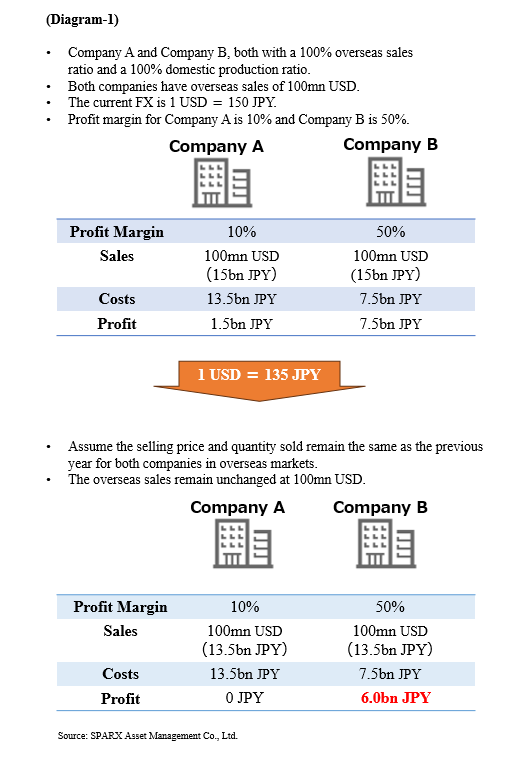
However, I have never been overly concerned about a strong JPY. The reason is that investing in Japan's high-quality global companies provides far more resilience against currency headwinds than investing in average exporters. Specifically, businesses with extraordinarily high-profit margins can minimize the negative impact of currency fluctuations. Let me explain with a simple example. Suppose there are two manufacturers, Company A and Company B. Both have a 100% overseas sales ratio and a 100% domestic production ratio. This year's overseas sales for both companies are $100mn, the current exchange rate is 150yen/USD, and the profit margin is assumed to be 10% for A and 50% for B. After converting to JPY, the P/L for A is 15bn yen in sales, 13.5bn yen in costs, and 1.5bn yen in profit, while for B it is 15bn yen in sales, 7.5bn yen in costs, and 7.5bn yen in profit. But what happens next year if JPY rises to 135yen/USD? All else equal, A's sales will decrease to 13.5bn yen, costs will remain at 13.5bn yen, resulting in zero profit, while B's sales will decrease to 13.5bn yen, costs will remain at 7.5bn yen, resulting in a profit of 6.0bn yen. In other words, while A's profit decreases by 100% compared to the previous year, B's profit only decreases by 27%. This is why I prefer businesses with high-profit margins. Keyence, for example, has been averaging OPM exceeding 50%. Our stress test suggests that even if JPY strengthens by 15 Yen against USD, the impact on operating profit would be immaterial. On the other hand, for a mediocre exporter with an OPM of less than 10%, 10-20% of profits (or even more) could be easily wiped out.
In addition, companies run by savvy management would consider mitigating currency risks by diversifying production bases overseas instead of exporting from Japan, and/or by matching sales and costs in the same currency. Let us think about the difference in production bases. Suppose there are two companies, Company C and Company D. C has a 100% overseas sales ratio and a 100% domestic production ratio, while D has a 100% overseas sales ratio and a 100% overseas production ratio. D conducts sales and production in the same region, and its production costs are denominated in USD. Like the previous example, this year's overseas sales for C and D are both USD100mn. The exchange rate is 150yen/USD, and assuming that the cost ratio is 90% (= profit margin 10%) at this exchange rate regardless of whether production is domestic or overseas, revenue and profit after converting to JPY is 15bn yen in sales, 13.5bn yen in costs, and 1.5bn yen in profit for both C and D. If the exchange rate strengthens to 135yen/USD, the profitability of the two companies will differ. C's sales will decrease to 13.5bn yen, but since all costs are incurred domestically, the cost will remain at 13.5bn yen, resulting in zero profit. On the other hand, if D's overseas sales are USD100mn and the cost ratio is 90% (= profit margin 10%), the profit generated locally will be USD10mn, resulting in a profit of 1.35bn yen after conversion to JPY. In other words, while C's profit decreases by 100% compared to the previous year, D's profit only decreases by 10%. Of course, even with diversified production bases, unexpected currency risks could occur if materials are procured from third countries or if exports are made from overseas production bases to other overseas markets and so on. However, in principle, a high-profit margin and localized production are some of the ways management can pursue to minimize forex sensitivity. During our research process, we closely examine business operations to identify well-run companies with a resilient business model.

It is also important to note that the longer the investment horizon, the more negligible the currency risk factor becomes. Toyota Motor Corporation, for example, was earning only around 700-800bn yen in pre-tax profits in the mid-1980s when JPY was much weaker than it is today (250yen/USD at the end of 1984). Fast forward to today, it is making over a whopping 4tn yen in OP even at 150yen/USD. This shows that in the long run, companies can overcome currency headwinds through their growth. I believe that investing in global businesses is a sensible approach to investing in Japan, where long-term demographic outlook, government debt and consistent fiscal deficits remain as issues.
* Possible triggers for a sudden appreciation of JPY include a potential large-scale currency intervention by BoJ or a severe recession in the US, leading to significant rate cuts by the Fed.
What will happen to Japan's interest rates and inflation in the future?
Next, let us consider the outlook for domestic interest rates. BOJ has made mistakes in the past by abolishing the zero-rate policy prematurely in 2000 under then-governor Hayami, and in 2006-2007 under Fukui after which Japan fell back into recession with worsening deflation. As such, my opinion is the current governor Ueda is more likely than not to err on the side of higher inflation before he follows through with further rate hikes. Japan may have finally come out of deflation, but BOJ appears to believe that it is still fragile. BOJ's monetary policy changes will likely be carried out by looking in the rear-view mirror, contrary to the Fed and ECB who moved swiftly to raise rates to pre-emptively curb inflation.
While the real interest rate is what the general consumer is concerned with, it is the nominal interest rate that matters to corporate earnings. Should my prediction about BOJ's next move prove to be correct, then BOJ's monetary policy framework will continue to be accommodative rather than restrictive leaving real interest rates below zero for the foreseeable future. Another way to look at this is that if inflation moves higher, BOJ can continue with the "normalization" of the interest rates whilst keeping the real rates negative so long as the economy does not falter. This is a Goldilocks-like scenario that I see as plausible particularly for Japan's commercial banking industry as they are the major beneficiaries of higher "nominal" interest rates. Better yet, insurance companies (expansion of insurance premium investment income is positive) and Orix (expansion of interest spread in Orix Bank, Orix Life, and its leasing business is positive) would also benefit from a healthy rise in domestic rates, contributing to business performance improvements. Continuous rise in interest rates is a phenomenon that has not occurred in Japan for years, and as such the stock market is still looking at the glass half empty, in my view.
If the rate hikes do not materialize as laid out here, these investments come with a reasonable margin of safety as well. Thanks to the cash-rich / asset-rich balance sheets (namely the "policy shareholdings" held on the balance sheets of general insurers and banks with massive unrealized gains accumulated over the last several decades) and the ongoing stock market reform on capital efficiency, these companies are expected to continue catering to shareholder returns through consistent share buybacks and dividend hikes. Many of financial names in the portfolio can deliver mid-to-high single-digit total shareholder returns sustainably and that is what I like about these investments.
Concerns around the potential deterioration of BOJ's financial condition should be overblown.
As a result of years of unprecedented quantitative monetary easing, BOJ's JGB holdings amount to nearly 600tn yen, about the size of the country's GDP. Given that the shareholders' equity of BOJ is around 12tn yen (calculated as the sum of "total net assets" and "provision for possible losses on bonds transactions" as of Sept 2023), mathematically if market rates are to keep rising, unrealized losses on these JGBs would widen, potentially exacerbating BOJ's financial condition to a point its equity falls into negative. Or the interest payments on the bank reserves from financial institutions could exceed the interest income from JGBs and dividend income from its ETF holdings, resulting in a negative spread (asset-liability mismatch). When such things are reported in the media, it may trigger a selloff in Japanese stocks, JGBs, and JPY. However, this should not be a cause of the market panic because in practice, BOJ, as the central bank of Japan, would never become insolvent as it can print money in JPY, its currency. There may be some side effects such as accelerating inflation, but I am certain that the economic activities will continue to carry on. Of course, reckless fiscal finance is a problem. If the creditworthiness of the nation's debt or JPY is in question, undesirable situations may occur. However, if speculative short selling of JGBs puts downward pressure on bond prices, the over 500tn yen of bank reserves sitting at BOJ's deposit account can be expected to return to the JGB market, helping to put a lid on long-term rate spike. I have yet to formulate my view on the details but in any scenario, I am of the view that my portfolio should be able to weather these tail risks better than the average portfolio.
Important Disclaimer
This content has been prepared by SPARX Asset Management Co., Ltd. (SAM) for information purpose only. Certain information contains economic trends and performance, however, SAM does not warrant the accuracy or completeness of such information, and accept no liability whatsoever for any direct or consequential loss arising from any use of this content. The views and opinions contained herein are based on then-current beliefs of the authors and are subject to change without notice. Furthermore, it should not be assumed that past performance is an indication of future results.